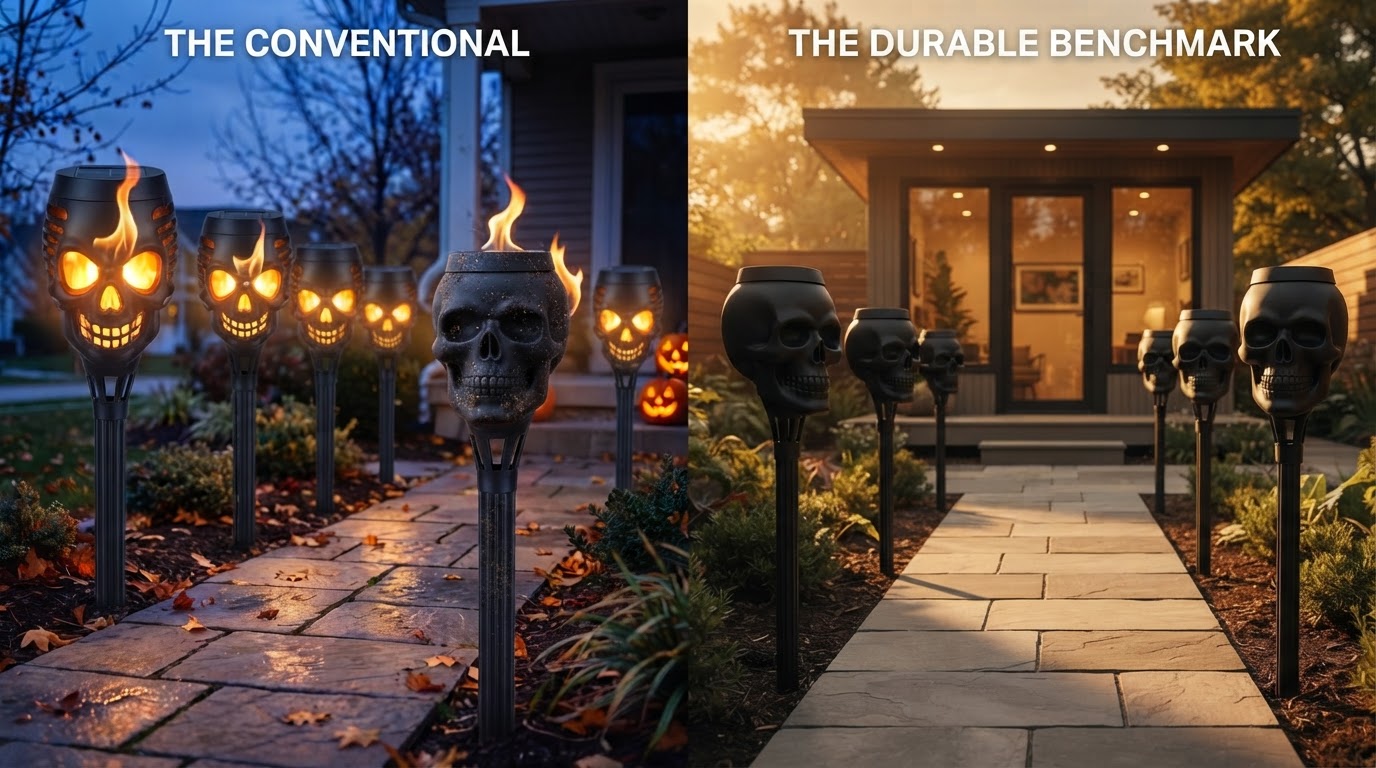
Solar Skull Torch Lights: The Three Durability Benchmarks
 Maya ChenContributing Editor
September 14, 2026 — The shift toward decorative solar lighting has reached a saturation point, yet Solar Skull Torch Lights continue to gain traction by addressing the common failure points of seasonal yard fixtures.
The conventional wisdom says that decorative lighting is inherently disposable, with most consumers expecting a single season of use before the internal circuitry succumbs to moisture ingress. However, data from the International Electrotechnical Commission regarding IP (Ingress Protection) ratings suggests that the gap between budget plastic stakes and engineered outdoor lighting is widening. While many generic options lack official certification, Solar Skull Torch Lights are built to withstand the specific thermal expansion and contraction cycles typical of autumn weather.
The Three Durability Benchmarks
Run the math: a standard solar fixture requires a minimum of six hours of direct sunlight to achieve an eight-hour discharge cycle, a ratio that many decorative products fail to meet during the shorter days of late September. Solar Skull Torch Lights utilize a high-efficiency monocrystalline silicon panel that maintains a higher conversion rate than cheaper thin-film alternatives. Here's the part nobody talks about: the battery chemistry. Most seasonal lights use low-capacity Ni-Cd cells that suffer from memory effect within three months. By contrast, these torch lights integrate lithium-ion cells designed for hundreds of cycles, ensuring the flickering flame effect remains consistent throughout the night. For those coordinating skull tiki torches for yard, the synchronization of light output is critical; inconsistent voltage in lower-tier products often leads to mismatched brightness levels across a landscape. Furthermore, the structural integrity of the stake itself determines long-term viability. When compared to basic halloween skull garden stakes, the reinforced ABS polymer used in these torches offers superior UV resistance, preventing the brittleness that leads to snapped poles in frozen soil. Even when paired with auxiliary accents like skeleton arm solar stakes, the primary torch units serve as the anchor for the visual layout, requiring a stable 1.2V to 3.7V output range to maintain the amber LED oscillation that mimics real combustion.
Expert tip: To maximize the lifespan of the internal sensors, ensure the solar collector is wiped with a microfiber cloth every two weeks to prevent dust buildup from throttling the charging current.
Effective seasonal lighting requires more than just aesthetics; it demands hardware that survives the elements. Integrating these units alongside a broader seasonal yard layout provides a cohesive look that doesn't fail after the first rainstorm. I'll change my mind when a competitor provides verified laboratory data showing a higher lumen-to-watt ratio in a similar form factor.
Shop Solar Skull Torch Lights.